Wednesday, September 20, 2006
The Pathology of Denial
The Give Up Blog has a post cataloging the tactics of denialists. Denialists are people who, for particular ideological reasons, dispute the consensus on certain subjects despite the overwhelming evidence that supports that consensus. Denialists come in many flavors: evolution deniers, HIV causes AIDS deniers, holocaust deniers, etc. Despite the particulars of what well-supported finding they deny across these groups, they all seem to draw from the same box of flawed reasoning and use of logical falacies to support their denial belief.
I've discussed this before with respect to a particular lesser-known denialist belief (Einstein denial), and Seth at Whiskey Before Breakfast has been ruminating on this with several posts trying to work out how and why this denial "memeplex" gets propagated.
As I commented on Seth's blog earlier, I think "denialism" can be adequately explained as a subset of credulous thinking. There's little difference between denying specific conclusions that are based on overwhelming evidence like evolution, AIDS, etc., and accepting pseudoscience like UFO abduction stories, astrology, and psychic phenomona with no supporting evidence. The latter enthusiasts of such credulous beliefs simply deny the overwhelming evidence that these things (UFO's, astrology, psychic powers) don't exist. And they use the same flawed reasoning and logical falacies to ignore all the evidence that points to more mundane explanations.
Still, it's illuminating to see all the common arguments laid bare for future profiling.
Labels: craziness, skepticism


Friday, August 25, 2006
Evolution, HIV, Holocaust, and ... Einstein Denial
Now I've seen everything. Apparently Albert Einstein did not develop the Theory of Relativity, but was in fact an "incorrigible" plagiarist who stole his ideas from every prominent scientist of the time. Needless to say, this seemed like an outrageous and unsubstantiated claim. However, this guy Christopher Jon Bjerknes published a book in 2002 detailing Einstein's supposed malfeasance.
Well, check out Mr. Bjerknes' entry on Wikipedia. Not much more info about his theory, other than the fact that he got into a flame war with another science historian, John Stachel, over his controversial thesis (not surprising). Then we find this little tibit:
Bjerknes and Winterberg have spoken up to defend some highly controversial figures, including David Irving and Arthur Rudolph. Despite being lionized in some articles at the White Nationalist Wiki, Bjerknes disavows any antisemitic motivation for his attacks on Einstein. Bjerknes has written himself on the Holocaust for the Holocaust denial "Committee for Open Debate on the Holocaust", claiming that "Racist Zionists" perpetuated the anti-Semitism of the Holocaust, as well as having later used the history of anti-Semitism as "a means to control public opinion in a most corrupt and deplorable fashion". He also claims that "Jewish racists helped to put Hitler into power in order to herd up the Jews of Europe and force them into segregation", that "Jewish racists collaborated with the Nazis to kill off the weakest Jews and preserve the best genetic stock for deportation to Palestine", and that, contrary to mainstream historical opinion, that the Nazis did not plot genocide at the Wannsee Conference.Hmmm... blaming the Jews, ... er, "Racist Zionists," for the Holocaust in some sort of elaborate conspiracy theory and defending the views of Holocaust deniers does a lot to impeach this guy's credibility in my estimation. Sort of seems like this Einstein-denial thing is just a specific manifestation of his general anti-Semitism. Still, I'd be employing the ad hominem logical falacy if I dismissed his arguments solely on the basis of his apparent anti-semitism.
So we turn to reliable source Cecil Adams of The Straight Dope to deliver a balanced view of the subject:
So, it seems there was nothing particularly sinister about Einstein after all (other than that he was left-handed, like me; look up the original meaning of sinister). If you go and John Stachel's critique of Bjerknes' book, you'll also find that Bjerknes employs tactics and arguments that have uncanny parallels to creationist propaganda, such as quote mining, and presenting self-contradictory, inconsistent criticisms.Questions of priority have long swirled around the theories of relativity, both special and general. Though no one thinks Einstein confected special relativity out of thin air, his 1905 paper had no notes or references, which was odd even for the times. In fact, as Einstein's critics long ago demonstrated, virtually all the better-known elements of the theory--most famously, the equivalence of matter and energy (E = mc²)--had previously been suggested by others. Two men in particular, French mathematician Henri Poincare and Dutch physicist Hendrik Lorentz, are credited with anticipating many of Einstein's discoveries.
Some latter-day writers have seized on these observations as proof that Einstein was a fraud, notably Christopher Jon Bjerknes, author of Albert Einstein: The Incorrigible Plagiarist (2002). The gist of his argument: (a) Einstein got many of his ideas from his first wife, Mileva Maric; (b) Maric herself plagiarized her ideas from others; and (c) the theory is a crock anyway. Clearly, some aspects of Bjerknes's attack operate at cross-purposes--if relativity is fatally flawed, who cares if it was pirated? More importantly, though he seems to have unearthed every remark ever penned that could conceivably be construed as undercutting Einstein's contribution, he never manages to demonstrate that Einstein ventured over the line between building on other people's work and stealing it.
Still, you ask, given that Big Al was just one of a bunch of scientists sniffing around the same turf at the same time, why did the Smartest Person Ever trophy go to him and not one of his contemporaries? Poincare, for instance, gave a prescient lecture in 1904 (Einstein doesn't seem to have been aware of it) that posited many aspects of special relativity, among them the idea that the speed of light was an impassable limit. So illuminatingly did he dilate on the issues that one historian of science professes bafflement that Poincare failed to invent the theory of special relativity himself. But he didn't. His comments make it clear he was still wedded to classical physics, with its comforting notion of space and time as unchanging verities. Einstein alone was able to make the conceptual leap and realize that space and time were about as immutable as Silly Putty, paving the way for our modern view of the cosmos as a profoundly strange place.
While one doesn't want to deprecate Einstein's intellectual boldness, the fact remains that he put together a puzzle all the pieces of which were then in plain sight. He himself conceded that had he not invented the theory someone else would soon have done so. (He thought the theory of general relativity, which he completed in 1915, was a more impressive achievement--although even there, controversy still rages about who first deduced the crucial equations, Einstein or German mathematician David Hilbert.) This is not to say that Einstein was unworthy of the esteem in which he continues to be held--merely that, like every other physicist who ever lived, he stood on the shoulders of giants.
Seth, if you're reading, you might want to add Einstein-denial to your list of crazy belief pathologies.
By the way, if you're wondering how I stumbled onto this little gem, I was looking for a particular science fiction story written by H.G. Wells (no, not The Time Machine), and I did a google search for "H G Wells higher dimensions." Bjerknes' website was the 5th result. However, after this diversion, I did find the story I was looking for eventually. I was looking for the Wells story becuase it was mentioned in a few comments I read on The Panda's Thumb in the Design Challenge thread. Talk about your unexpected detours!
Labels: craziness, Einstein, skepticism
Tuesday, June 27, 2006
Does The Left Pander to Astrology?
Via Pharyngula, I came across this article by the Comissar, a conservative blogger who runs the Politburo Diktat. He asserts that there's evidence to indicate that liberals and Democratic politicians are hypocritical in their support of science since they are "soft" on the astrology proponents in their own camp while they are harshly critical of creationists and Intelligent Design (ID) proponents from the Right:
"Does the Left have a segment of their base that believes a certain pseudo-science, a segment their leaders are reluctant to antagonize? Is astrology quietly acceptable within the "progressive" community? The Left takes great pleasure in bashing Republican Creationists and ID advocates (quite appropriately, and I join them in this, as my readers know)."He then presents the case of Jerome Armstrong, the Internet advisor to Democratic Virginia governor and potential presidential candidate Mark Warner. To be sure, this guy seems to have been involved in some nutty stuff with using astrology "predictions" to plan political strategy. Conservatives have been having a good laugh at his expense after unearthing some pretty wacky stuff he wrote a few years ago. Jerome Armstrong is also apparently closely affiliated with DailyKos, a prominent liberal blog.
I confess I'm not really plugged in to the liberal/conservative blogosphere, and there appears to be several layers of sniping back and forth between these bloggers (I spend most of my blog-reading time on ScienceBlogs and Panda's Thumb). I would consider myself a "liberal" and "progressive" but I'm not familiar enough with the positions of these bloggers to defend or criticize their positions on either side. So I'll stick to the Commissar's main argument rather than delve into the side issues of liberal vs conservative blog integrity.
So, the Commissar has presented what seems at first to be a claim worth investigating further. Does The Left tacitly give a free pass to the psedoscience of astrology while vigorously attacking creationism and ID so as not to antagonize a segment of their base? Is this a blow to liberals' pro-science image? The Commissar presents a challenge to "the Left's 'Defenders of Science'":
"An advisor [referring to Jerome Armstrong] to a serious Democratic presidential candidate is an astrologer, as well as an admitted stock swindler. [bold in original] 29% of Americans believe in astrology. I think a little distancing would be in order, from the Left’s “Defenders of Science.” (If they have in the past, I’d be delighted to correct this post.)"He specifically calls out PZ Myers, DarkSyde of DailyKos, Ed Brayton, and Brent Rasmussen as liberal science bloggers who have not publicly denounced astrology. Curiously, he doesn't mention Chris Mooney, the author of The Republican War on Science. I'd think he'd be a prominent liberal science supporter who should be included, no? Well, searching his blog, I did find a post that conveys his attitute toward astrology. Short answer, he thinks it's crap.
Anyway, true to his word, after most of these people responded to his post, he updated his article and linked to their responses:
"Prompt posts that display real integrity on this issue from PZMyers and Brent Rasmussen. Along with his usual overdose of personal and childish invective, Myers documents his previous denunciations of astrology. Fair enough. DarkSyde contents himself with 'Bush is worse,' and declines to exercise his much-ballyhooed independence at dKos’ front page by denouncing astrology there.In fact, I found his post via the link from PZ Myers' response. Ed Brayton also has no tolerance for astrology, and is a libertarian to boot. The Commissar also admitted to mistakenly labelling Ed as a liberal and apologized in his post.
Or maybe astrology is just one of 'several different predictive mathematical disciplines?'"
In addition to these points, the Commissar also links to a comment by Jay Ackroyd somewhat supportive of Jerome Armstrong's astrology at Glenn Greenwald's blog and to a couple of "Leftie politics/astrology sites of interest" as further evidence of the influence of Astrology on the Left: HPLeft and the Democracy Cell Project.
So, to recap, the evidence that "astrology [is] quietly acceptable within the 'progressive' community" includes:
- Jerome Armstrong, advisor to Mark Warner appears to be a bit of a flake and buys into astrology.
- 29% of Americans believe in astrology.
- DarkSyde asserts that he denounces astrology, but he has not publicly proclaimed it from the relatively large forum of DailyKos that is available to him. To the Commissar, this apparent reticence is an indication of his unwillingness to antagonize the Left's astrology wing.
- A commenter on a liberal blog is okay with Jerome Armstrong believing in astrology.
- There are two "Leftie" organizations that buy into astrology.
The fact that 29% of Americans believe in astrology is an interesting data point, but it doesn't make the case. Especially when another commenter on the Commissar's blog points out:
"A quick google of a Harris poll show 21% of R[epublicans] and 28% of D[emocrats] admit to believing strology. Hardly a matter of 'our pseudo-scientists'."Since I'm not familiar with DarkSyde, I have no idea how much his views are influential to the Democratic party or liberals and progressives. Even a prominent liberal blogger seems to be of limited influence to me. Anyway, he's already declared he thinks astrology is crap, but he hasn't put a new post on the front page of DailyKos. The Commissar finds this significant, but it's a rather weak bit of evidence on its own. DarkSyde has already responded in the comments of the Commissar's post several times with what seem like reasonable answers as to why he hasn't put a post on DailyKos.
I have no idea who Jay Ackroyd is, but if he's a mover and shaker in the Democratic Party, I'll give more weight to his comment on Glenn Greenwald's blog. Otherwise, he's a private citizen who doesn't represent the Democratic leadership or liberals in general.
Looking at the two "Leftie" organizations that are into astrology, HPLeft does appear to be a bit loony and endorses astrology as one of the "wisdom technologies" that are returning from obscurity. And the Democracy Cell Project, while saying nothing about astrology on their site, is running articles by Matthew Carnicelli, the publisher of the HPLeft site. So maybe the Democracy Cell Project doesn't endorse astrology, but they haven't gone out of their way to denounce it. Are these organizations significant among liberals or the Democratic Party? Do their members hold positions of influence among the Left? Would Democratic politicians be reticent about calling astrology crap for fear of losing the support of these groups? I see no evidence of this.
It seems to me that astrology is pretty much a non-issue for both Democrats and Republicans. Astrologers on the whole seem to be less interested in gaining political power by influencing Democrats and more interesting in separating the gullible from their money. The Commissar sees the general silence of liberals on astrology as evidence of their tacit acceptance of astrologers in their camp and of their unwillingness to "rock the boat" by denouncing astrology as pseudoscience.
However, if we are to take this assertion seriously, we must eliminate the alternative hypothesis that Democrats don't address astrology because astrology is simply not a pressing political issue that deserves attention. And if we're going to posit that the analogy that astrology is the "Left's Creationism" then we need to show that astrologers have an organized lobby that has significant influence in the Democratic agenda that is equivalent to how much influence creationists and ID proponents have on Republican politicians. Well, let's compare creationists on the Right to astrologers on the Left.
Creationists and ID proponents ...
- ... have school boards in Kansas, Ohio, Pennsylvania, and Alabama trying to insert their ideas in public school science classes.
- ... have Republican politicians introducing legislature in several states to get their pseudoscience taught in public school science classes.
- ... have a Republican senator (Rick Santorum) trying to insert "criticism" of evolution into national education legislature.
- ... have the Republican president of the United States endorsing "teaching the controversy" between ID and evolution. He also supported "teaching the controversy" between creationism and evolution when he was governor of Texas.
- ... have the full-fledged support of the influential Religious Right.
- ... have the ear of an advisor to Democratic presidential hoepful Mark Warner. Well, not exactly. This advisor dabbled in astrology, but he doesn't seem to be affiliated with any astrology organizations. It's also unclear whether Mark Warner himself endorses astrology.
- ... have two liberal organizations that somewhat support astrology with unclear (but apparently marginal) influence in the Democratic Party.
- ... have anything else?
"My visitors from Pharyngula are unanimous: 'Our pseudo-scientists are not as bad as your pseudo-scientists.'Oh yeah, did I forget to mention that the most well-known story of astrology's impact on politics seems to be the fact that Nancy Reagan consulted an astrologer to plan her appointments while her husband was president? But that bit of data is apparently irrelevant.
and, oh yes, 'Nancy Reagan … Nancy Reagan .. Nancy Reagan'"
The point that the Commissar seems to miss is that astrology is not a partisan phenomenon. Astrologers aren't the "Left's pseudo-scientists," as the Harris poll shows. Astrology adherents cut across the entire political spectrum relatively evenly. Creationists and ID proponents, on the other hand, are firmly aligned with Republicans and are pandered to by Republican politicians. This seems to be a significant difference that undermines his argument.
Well, at least I do agree with the Commissar on two points: creationism and ID are bunk, and astrology is bunk. But I fail to see the point of trying to tie liberals to astrology in the same way conservatives are linked to creationism and ID. The evidence he's presented just isn't compelling and doesn't support his thesis.
Labels: culture wars, science, skepticism
Thursday, May 25, 2006
35th Skeptics' Circle: Special Creationist Edition
The 35th Skeptics' Circle is up, and I submitted one of my posts for inclusion. This is my first participation in a blog carnival, and I'm glad I got a chance to contribute. This week the Skeptics' Circle is hosted by Skeptico, who's been having a bit of trouble with a creationist blog doppelganger lately. Gracious guy that he is, Skeptico let his doppelganger narrate the posts in the Skeptics' Circle (not really). Well, creationists are skeptical of evolution, so this Skeptico doppelganger is on to something right? Er, um, yeah. So anyway, check it out and enjoy!
Labels: skepticism
Thursday, May 04, 2006
Illegal Immigration, the Economy, and Statistics
Update 5/25/2006: This post is featured in the 35th Skeptics' Circle, hosted by Skeptico. Welcome, fellow skeptics!
I was inspired by MarkCC's Good Math, Bad Math blog to examine more closely what looked to be a fishy use of statistics. On the continuing illegal immigration debate, I found this New York Times article about the economic impact of illegal immigrants in the United States (discovered via David Neiwert's, Daniel Drezner's, and Kevin Drum's blogs). The main thesis of the article is that economists have analyzed the effect of illegal immigration on the American economy, and discovered that the actual impact has been much lower than expected. To quote the article:
As Congress debates an overhaul of the nation's immigration laws, several economists and news media pundits have sounded the alarm, contending that illegal immigrants are causing harm to Americans in the competition for jobs.The article also presents a graphic showing a comparison between the percentage of illegal immigrants versus the median hourly wage for high school dropouts in 9 selected states.
Yet a more careful examination of the economic data suggests that the argument is, at the very least, overstated. There is scant evidence that illegal immigrants have caused any significant damage to the wages of American workers.
Okay, so this article seems to refute the claim that illegal immigrants are a significant drain on the American economy, right? However, Steve Sailer disagrees with a post on the VDARE blog entitled: The Uselessness of Economists on Immigration. He notes:
An accompanying graphic shows that a high school dropout in California, where supposedly 6.9% of the population are illegal immigrants, averages $8.71 per hour in wages versus merely $8.37 in Ohio, where only 1.0% are illegal immigrants.He then lists the numbers from the article's graphic and adds in the median wages corrected for the cost of living index (corrected wage = 100 * wage/(cost of living index)):
Case closed!
Well, no, not exactly. What about the cost of living difference between California and Ohio? Don’t they tell you in Econ 101 and in Journalism 101 to always adjust for the cost of living?
According to the data gathered by the nonprofit organization ACCRA, which measures cost of living so corporations can fairly adjust the salaries of employees they relocate, California has the highest cost of living in the country with an index of 150.8 (where 100 is the national norm). Ohio is below average at 95.4. So, relative to the national average cost of living, high school dropouts in Ohio average $8.77 versus $5.78 for the equivalent in California. That means they are 52% better off in Ohio.
| State | Illegal Immigrant % by Population | HS Droput Median Wage | Cost of Living Index | Adjusted HS Dropout Median Wage |
|---|---|---|---|---|
| Nevada | 7.5% | $10.05 | 111.8 | $8.99 |
| California | 6.9% | $8.71 | 150.8 | $5.78 |
| Florida | 5.2% | $8.99 | 100.3 | $8.99 |
| Maryland | 4.5% | $9.84 | 125.8 | $7.82 |
| New Jersey | 4.1% | $9.03 | 134.2 | $6.73 |
| New York | 3.3% | $9.02 | 123.5 | $7.30 |
| Nebraska | 2.3% | $9.08 | 93.3 | $9.73 |
| Ohio | 1.0% | $8.37 | 95.4 | $8.77 |
| Kentucky | 0.9% | $8.73 | 91.2 | $9.57 |
He precedes this table with the following comment:
Here’s the data from the NYT’s graphic, in which 9 states were cherry-picked to make it look like the higher the percentage of illegal immigrants in a state’s population, the better off high school dropouts are (r=+0.58). I’ve added the two right hand columns to adjust for the big cost of living differences. We then find a negative correlation of r = -0.46 between the percentage of illegal immigrants and the cost-of-living-adjusted median wage for high school dropouts. Quite a difference!But does this actually refute the point of the article? "Cherry-picking" aside, the article never claims that "the higher the percentage of illegal immigrants in a state’s population, the better off high school dropouts are." Also, I doubt the actual studies done by the economists mentioned in the article only encompasses the data for these nine states.
Mr. Sailer has a point that the newspaper article should have corrected the median wage numbers for cost of living across different states. However, the corrected figures don't exactly prove his contention that illegal immigrants are significantly depressing the high school dropout median wages. He points out the disparity between California and Ohio when the numbers are corrected for cost of living, but ignores the fact that Nevada has a higher percentage of illegal immigrants than even California, and *still* has a higher median wage than Ohio, even after the numbers are adjusted.
In fact, just glancing at the table, it appears to me that the biggest effect on the corrected median wages is in fact the cost-of-living index. Of course, this is not surprising given that the corrected median wages are calculated by and thus dependent on the cost-of-living index. But what about the correlation coefficients Mr. Sailer calculated? Can we draw any meaningful conclusions from them? (If you're unfamiliar with correlation coefficients and their use in statisitics, check the Wikipedia article for a helpful summary.)
Let's calculate the correlation coefficients between every pair of columns in Mr. Sailer's table (numbers and figures generated by UCLA Dept of Statistics' Correlation and Regression Calculator):
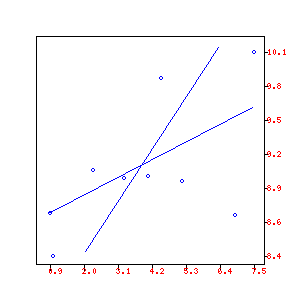 Illegal Immigrant Population % vs HS Dropout Median Wages r = 0.58 | 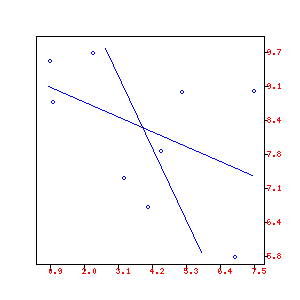 Illegal Immigrant Population % vs Adjusted HS Dropout Median Wages r = -0.46 |
|---|---|
 Cost-of-Living Index vs Adjusted HS Dropout Wages r = -0.96 | 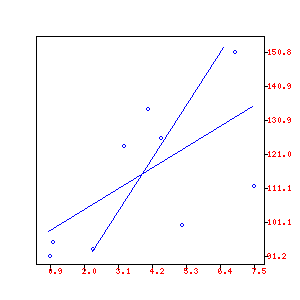 Illegal Immigrant Population % vs Cost-of-Living Index r = 0.63 |
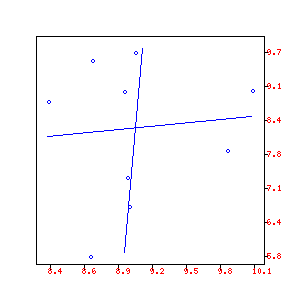 HS Dropout Wages vs Adjusted HS Dropout Wages r = 0.09 | 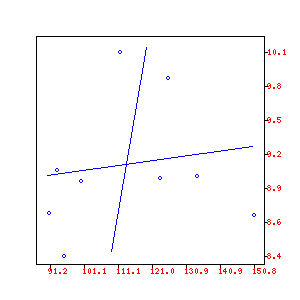 Cost-of-Living Index vs HS Dropout Wages r = 0.16 |
The first row of the table shows the correlation coefficients Mr. Sailer calculated. The values 0.58 and -0.46 seem significant until you look at the data plotted in a graph. Looking at the graph, this data doesn't convince me that there's much of any causal relationship between illegal immigrant population and high school dropout median wage, regardless of whether or not you correct for the cost-of-living index.
In the second row, as I predicted, we see a strong correlation between cost-of-living index and the adjusted HS dropout median wage. But perhaps the illegal immigrant population adversely affects the cost-of-living index, and thus we'd be justified in claiming that the illegal immigration population indirectly affects the high school dropout median wage? Well, the figure on the right graphs the illegal immigrant population vs cost-of-living index. The correlation coefficient is a slightly higher (than the coefficients in the first row) 0.63, but looking at the graph, the data points still look all over the place. That doesn't seem like a convincing causal relationship either.
In the third row, for completeness, I've added the correlation calculations between the other combinations of data columns. These columns do not have relevant relationships to each other and thus it is not surprising that their correlation coefficients are low.
Of course, the real problem is that it's unreasonable to draw any substantial conclusions about illegal immigration's affect on high school dropout median wage from nine measily data points. And I don't think the Times article was trying to do that. The graphic is a supplemental material, and the caption states:
The estimated number of illegal immigrants in a state's population shows no apparent correlation with the median wage for less educated workers in that state.This is a much weaker statement than Mr. Sailer's interpretation that the graphic "cherry-picked" the data to try to make it look like "the higher the percentage of illegal immigrants in a state’s population, the better off high school dropouts are."
I do have to agree that it is misleading to not correct for the cost-of-living index for the median wage figures. But even it that were done, as the analysis above shows, that doesn't invalidate the graphic caption's assertion.
I think a substantial critique of the Times article would address the data actually used in the studies published by the economists. It seems unfair to claim economists are "useless" on immigration without addressing the studies they published, rather than the snippet of data published in the article.
A significant criticism I have with the Times article is that they don't reference the actual studies done. They mention a bunch of economist researchers but don't provide citations to help actually track down the studies. Fortunately we live in the age of Google. For the interested, here are links to the studies mentioned in the article:
- George J. Borjas and Lawrence F. Katz, The Evolution of the Mexican-Born Workforce in the United States
- David Card, Is the New Immigration Really So Bad?
- David H. Autor, Lawrence F. Katz, Melissa S. Kearney, The Polarization of the U.S. Labor Market
Labels: immigration, skepticism
Saturday, April 15, 2006
Avoiding the Perils of the Internet
I don't think it's an understatement to say that the Internet is as much a revolution in human communications as television, radio, or the printing press were when they were first introduced. The Internet puts the entire wealth of accumulated human knowledge at your fingertips. No previous generation had such immediate access to so much information. And the poplarity of the World Wide Web, combined with the proliferation of blogs, homepages, etc. truly makes free speech real for the entire population. In principle, anyone can publish anything they want on the Web and have it potentially be read by everyone else.
OK, that's the rosey, naive utopian vision of the Internet. The unfortunate reality is that the Internet is equal parts amazing universal knowledge database, cess pool of lies and misinformation, welcoming communities for people to find other people with similar interests, outlet for still other people to exercise their worst anti-social impulses anonymously, forum to debate and discuss important issues, and platform to spew the most vile propaganda and smear campaigns.
The truth is the fact that the Internet makes free speech real is both its greatest strength and its greatest weakness. You can't blindly trust every web page you visit or every email you receive. To make the most of the Internet, you have to put a bit of work into making sure the information you're getting is accurate.
So, in the interest of helping my fellow web surfers, here are some sites that I think are trustworthy and can help you avoid getting sucked into the cess pool:
- Snopes Urban Legends Reference Pages - Ever get an email with a story that's too unbelievable to be true? Well, you're probably right. Check this site to find out which stories are just urban legends, and which are based on facts.
- FactCheck.org - It's a given that all politicians lie, right? This site researches the public statements politicians make and determines what's factual, what's exaggeration, and what's just plain false. Whether you're a Democrat or Republican, liberal or conservative, this site doesn't play favorites. This site focuses on US politics, so it's maybe only relevant for American citizens.
- The Straight Dope - Cecil Adams answers readers' questions about a wide range of topics. He and his staff always provide background references and research so that you can verify their findings. If you have a question that no one seems to be able to answer, check here. If they don't have the answer already, you can ask them.
- How Stuff Works - We live in amazing times where technology provides us with so much convenience in our everyday lives. But we rarely take the time to understand how all these marvelous machines and tools work. This site solves that problem. Each article provides clear explanations with lots of pictures and diagrams on a variety of human technology and the workings of the universe. You don't need an advanced science or engineering degree to understand how stuff works, just plain old human curiosity.
Labels: Internet, skepticism
